There was no plan to turn the afternoon into an excavation. The detector had simply come out for a slow pass across an old garden, the kind of ground where modern clutter and older metal can sit close together beneath turf, roots and compacted soil.
It started as a walk, not a search for a particular object
The first sweeps were ordinary. The coil moved low and level over the grass while the operator listened for changes in tone and watched for responses that appeared in the same place more than once. Small, inconsistent sounds were left alone. Then one signal cut through with enough strength and repeatability to justify stopping.
Rather than digging immediately, the spot was crossed again from a different direction. The response remained. A slower pass narrowed the area, and another check confirmed that this was not a single stray chirp caused by an awkward sweep. The signal was tied to one patch of ground.
The unusual signal was checked again before the ground was opened
The detector was passed over the area several more times, keeping the coil height steady. The response did not disappear. That persistence changed the pace: instead of sweeping onward, the search became a small investigation focused on one point.
The turf was opened carefully and the loose soil kept close to the cut. The first stage revealed nothing obvious. A little deeper, the soil became darker and more compacted, suggesting that the object had been covered for a long time.
Pass from one direction, cross the target, then slow the sweep before digging.
Valuable find discovered underground – everyone was surprised
The surprise came from scale, not from any claim about contents or value. As soil was removed from the edge of the hole, a broad, flat metal surface appeared rather than a small isolated object. More careful digging exposed corners, a heavy front face and hardware that made the shape increasingly difficult to mistake.
Only after enough earth had been cleared around it did the outline make sense: an old metal safe had been buried beneath the garden. Its surfaces were heavily soiled and weathered from long contact with the ground. Nothing about the discovery alone established who had owned it, when it had been placed there or what, if anything, was inside.
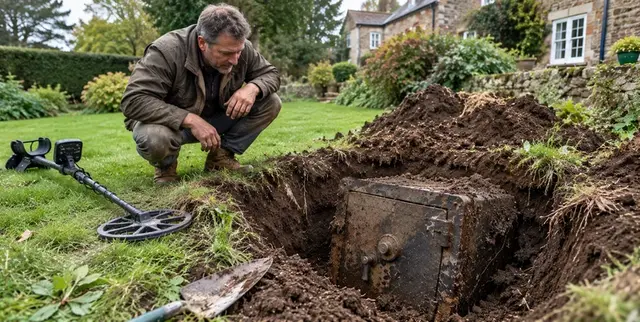
That distinction matters. Metal detecting can identify a response from a metallic object and help narrow where to investigate, but it does not turn a signal into a promise. Here, the compelling part of the story was the sequence itself: signal, re-check, careful recovery and finally the appearance of a large object that had been hidden by soil.
The shape only became obvious after the edges were cleared
Large buried objects can make a search feel deceptively simple once they are visible. Before the first corner appeared, however, there was only a response under the coil and a patch of ground. The recovery still depended on restraint: widening the hole gradually, avoiding unnecessary force and checking the exposed area as the outline became clearer.
When the safe was finally free enough to inspect, its age was visible in the condition of the metal rather than in any verified historical story. Corrosion, soil and the weight of the object explained why the recovery took time. The object was lifted and examined as found, without inventing a value, owner or contents that the evidence did not establish.
Three field moments, viewed one at a time
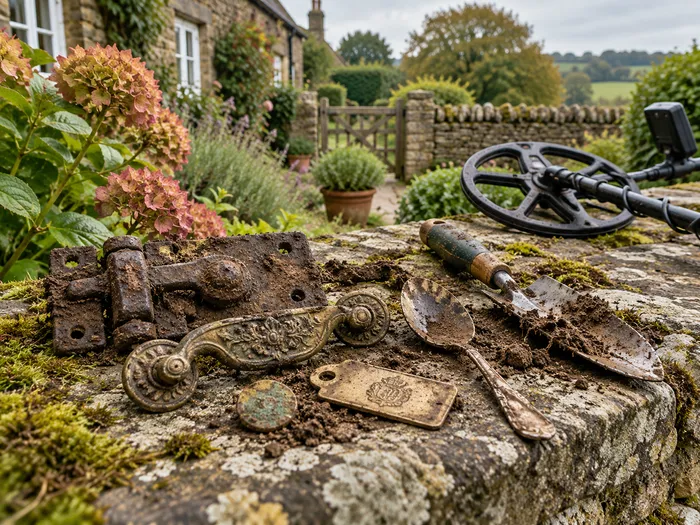
Use the arrows to move through the three photographs. Each image keeps its own field note beneath it, so the context changes together with the picture.
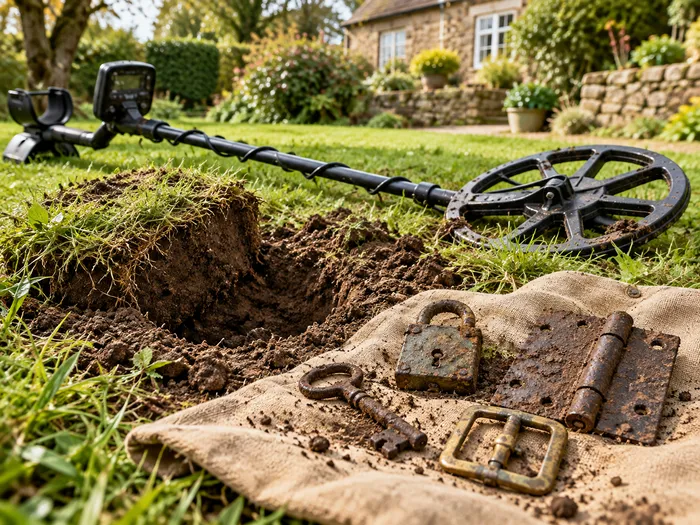
A repeatable response led to a small controlled excavation, with ordinary metal finds laid out for inspection beside the detector.

What the detector contributed was repeatability, not certainty
A metal detector works by transmitting an electromagnetic field from its search coil into the ground. When a metallic object interacts with that field, the detector receives a response and converts it into information the user can hear and, depending on the model, see on the display.
The useful part in a garden search is not that the machine can tell the complete story of an object. It cannot. Instead, it helps the operator identify where a response is consistent, compare tones and target information, and decide whether a particular area is worth checking more carefully.
The coil creates the search field as it passes close to the ground.
Metal changes the received signal according to its properties and position.
The detector turns the response into tones and target information.
Luxury find discovered underground – everyone was left speechless
The headline captures the reaction to uncovering a substantial safe where only grass and soil had been visible moments before. It is not a claim that the safe contained luxury goods, money, jewellery or any other treasure. The discovery itself was enough to stop the search and draw attention to what years underground had concealed.
That is also the more realistic way to understand metal detecting. A strong signal can justify a closer look, but signal strength does not establish monetary value. Object size, depth, metal type, orientation and ground conditions can all affect the response, so the detector remains a search tool rather than a guarantee of what will be recovered.
From the garden story to the detector itself
The equipment used for this kind of hobby search has one practical job: make repeated scanning simple enough that the operator can concentrate on sweep speed, overlap and changes in tone. That is where the Minelab VANQUISH 340 fits naturally into the story. It is a lightweight model built around Minelab's Multi-IQ simultaneous multi-frequency technology and straightforward preset controls.
Its three search modes are Coin, Jewellery and All Metal. Four sensitivity levels, three target tones and five discrimination segments give the user a small, understandable set of adjustments rather than a dense menu system. For an old garden, that means the setup can stay simple while the user focuses on whether a response repeats from more than one direction.